

Navigation menu
Search
Databases
All Databases
Audiobook
Made for Success; Foote, Bill
Made for Success
, 2021
; English
The Pauline epistles, also called Epistles of Paul or Letters of Paul, are part of the canon of the New Testament and are foundational texts for both Christian theology and ethics.
The Pauline Epistles are the 13 letters written by the apostle Paul that are included in the canon of Scripture. The Pauline Epistles are Romans, 1 Corinthians, 2 Corinthians, Galatians, Ephesians, Philippians, Colossians, 1 Thessalonians, 2 Thessalonians, 1 Timothy, 2 Timothy, Titus, and Philemon.
The Pauline Epistles contain much of the doctrine the Christian faith is built upon, especially in relationship to salvation. The Pauline Epistles expound on the doctrines of sanctification, justification, redemption, and reconciliation. The Pauline Epistles contain significant teachings on difficult theological issues such as election, predestination, foreknowledge, the deity/humanity of Christ, God's ongoing relationship with Israel, and the Judgment Seat of Christ. The Pauline Epistles also get very practical in how the church should function, containing teaching on spiritual gifts, qualifications of church leaders, the role of women in ministry, and the relationship between law and grace in the life of a Christ-follower.

Audiobook
Made for Success; Foote, Bill
Made for Success
, 2021
; English
The Pauline epistles, also called Epistles of Paul or Letters of Paul, are part of the canon of the New Testament and are foundational texts for both Christian theology and ethics.
The Pauline Epistles are the 13 letters written by the apostle Paul that are included in the canon of Scripture. The Pauline Epistles are Romans, 1 Corinthians, 2 Corinthians, Galatians, Ephesians, Philippians, Colossians, 1 Thessalonians, 2 Thessalonians, 1 Timothy, 2 Timothy, Titus, and Philemon.
The Pauline Epistles contain much of the doctrine the Christian faith is built upon, especially in relationship to salvation. The Pauline Epistles expound on the doctrines of sanctification, justification, redemption, and reconciliation. The Pauline Epistles contain significant teachings on difficult theological issues such as election, predestination, foreknowledge, the deity/humanity of Christ, God's ongoing relationship with Israel, and the Judgment Seat of Christ. The Pauline Epistles also get very practical in how the church should function, containing teaching on spiritual gifts, qualifications of church leaders, the role of women in ministry, and the relationship between law and grace in the life of a Christ-follower.
eBook & Audio
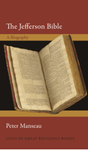
The Jefferson Bible : a biography
Manseau, Peter
Princeton University Press
, 2020
; English
; 234 Pages
In his retirement, Thomas Jefferson edited the New Testament with a penknife and glue, removing all mention of miracles and other supernatural events. Inspired by the ideals of the Enlightenment, Jefferson hoped to reconcile Christian tradition with reason by presenting Jesus of Nazareth as a great moral teacher—not a divine one. Peter Manseau tells the story of the Jefferson Bible, exploring how each new generation has reimagined the book in its own image as readers grapple with both the legacy of the man who made it and the place of religion in American life.
Completed in 1820 and rediscovered by chance in the late nineteenth century after being lost for decades, Jefferson’s cut-and-paste scripture has meant different things to different people. Some have held it up as evidence that America is a Christian nation founded on the lessons of the Gospels. Others see it as proof of the Founders’ intent to root out the stubborn influence of faith. Manseau explains Jefferson’s personal religion and philosophy, shedding light on the influences and ideas that inspired him to radically revise the Gospels. He situates the creation of the Jefferson Bible within the broader search for the historical Jesus, and examines the book’s role in American religious disputes over the interpretation of scripture. Manseau describes the intrigue surrounding the loss and rediscovery of the Jefferson Bible, and traces its remarkable reception history from its first planned printing in 1904 for members of Congress to its persistent power to provoke and enlighten us today.
eBook & Audio
Manseau, Peter
Princeton University Press
, 2020
; English
; 234 Pages
In his retirement, Thomas Jefferson edited the New Testament with a penknife and glue, removing all mention of miracles and other supernatural events. Inspired by the ideals of the Enlightenment, Jefferson hoped to reconcile Christian tradition with reason by presenting Jesus of Nazareth as a great moral teacher—not a divine one. Peter Manseau tells the story of the Jefferson Bible, exploring how each new generation has reimagined the book in its own image as readers grapple with both the legacy of the man who made it and the place of religion in American life.
Completed in 1820 and rediscovered by chance in the late nineteenth century after being lost for decades, Jefferson’s cut-and-paste scripture has meant different things to different people. Some have held it up as evidence that America is a Christian nation founded on the lessons of the Gospels. Others see it as proof of the Founders’ intent to root out the stubborn influence of faith. Manseau explains Jefferson’s personal religion and philosophy, shedding light on the influences and ideas that inspired him to radically revise the Gospels. He situates the creation of the Jefferson Bible within the broader search for the historical Jesus, and examines the book’s role in American religious disputes over the interpretation of scripture. Manseau describes the intrigue surrounding the loss and rediscovery of the Jefferson Bible, and traces its remarkable reception history from its first planned printing in 1904 for members of Congress to its persistent power to provoke and enlighten us today.

Audiobook
Jones, James Earl; Sherberg, Jon
Topics Media Group
, 2019
; English
James Earl Jones (New Testament reading) and Jon Sherberg (Old Testament) combine their incredible vocal talents in one of the most critically acclaimed Holy Bible recordings ever. These two lush baritone vocals are the perfect complement to one another.
Mr. Jones' skilled and resonating reading has been hailed as one of the greatest New Testament recordings of all time. Combined with Jon Sherberg's powerful and passionate delivery of the Old Testament, this beautiful audio rendition of The Holy Bible will leave your heart full and spirt nourished.
Jones, James Earl; Sherberg, Jon
Topics Media Group
, 2019
; English
James Earl Jones (New Testament reading) and Jon Sherberg (Old Testament) combine their incredible vocal talents in one of the most critically acclaimed Holy Bible recordings ever. These two lush baritone vocals are the perfect complement to one another.
Mr. Jones' skilled and resonating reading has been hailed as one of the greatest New Testament recordings of all time. Combined with Jon Sherberg's powerful and passionate delivery of the Old Testament, this beautiful audio rendition of The Holy Bible will leave your heart full and spirt nourished.
