


Navigation menu
Search
eBook
Engineering Elixir applications : navigate each stage of software delivery with confidence
Fairholm, Ellie; D'Lacoste, Josep Giralt
Pragmatic Bookshelf
, 2025
; English
; 450 Pages
The days of separate dev and ops teams are over - knowledge silos and the "throw it over the fence" culture they create are the enemy of progress. As an engineer or developer, you need to confidently own each stage of the software delivery process. This book introduces a new paradigm, BEAMOps, that helps you build, test, deploy, and debug BEAM applications. Create effective development and deployment strategies; leverage continuous improvement pipelines; and ensure environment integrity. Combine operational orchestrators such as Docker Swarm with the distribution, fault tolerance, and scalability of the BEAM, to create robust and reliable applications. BEAMOps starts by building a solid foundation for your project. On the infrastructure side, see how to use Terraform before you even start coding to automate your deployment and operations. On the project management side, we show you how to use issues and milestones to simplify tracking; you'll use this foundation as you go through the book, implementing each of the steps required to deploy a scalable Elixir application. Now that you have a foundation, you can start building. Create a Phoenix LiveView application and explore mix releases. Make your deployments reliable with Docker. Continuously improve your codebase by implementing an efficient continuous deployment/integration pipeline with GitHub Actions. Scale the Phoenix LiveView application and operate a distributed BEAM system in production using AWS EC2 nodes, AWS load balancers, and a remote Docker swarm. Recognize which application metrics should be collected and monitored, and set alerts when certain thresholds are met to ensure that your application auto-scales. Ship less code more often, and ensure it works! The pragmatic BEAMOps approach that we teach in this book - an extension of the well-known DevOps paradigm - will help you become a multidisciplinary developer who is empowered to own each stage of the software delivery process. After reading this book, you'll understand how to apply the BEAMOps principles in your daily work, creating reliable, scalable, and easy to understand applications in a cooperative team environment. What You Need: Elixir 1.16.0 (compiled with Erlang/OTP 26) Phoenix framework 1.7.0 Erlang 26.2.1 Terraform v1.7.1 Docker v20.10.22 Packer v1.9.0 Docker Compose v2.21.0 SOPS 3.8.1 Age 1.1.1 An AWS account AWS CLI v2.15.15 A GitHub account GitHub CLI v2.42.1 jq v1.7
Fairholm, Ellie; D'Lacoste, Josep Giralt
Pragmatic Bookshelf
, 2025
; English
; 450 Pages
The days of separate dev and ops teams are over - knowledge silos and the "throw it over the fence" culture they create are the enemy of progress. As an engineer or developer, you need to confidently own each stage of the software delivery process. This book introduces a new paradigm, BEAMOps, that helps you build, test, deploy, and debug BEAM applications. Create effective development and deployment strategies; leverage continuous improvement pipelines; and ensure environment integrity. Combine operational orchestrators such as Docker Swarm with the distribution, fault tolerance, and scalability of the BEAM, to create robust and reliable applications. BEAMOps starts by building a solid foundation for your project. On the infrastructure side, see how to use Terraform before you even start coding to automate your deployment and operations. On the project management side, we show you how to use issues and milestones to simplify tracking; you'll use this foundation as you go through the book, implementing each of the steps required to deploy a scalable Elixir application. Now that you have a foundation, you can start building. Create a Phoenix LiveView application and explore mix releases. Make your deployments reliable with Docker. Continuously improve your codebase by implementing an efficient continuous deployment/integration pipeline with GitHub Actions. Scale the Phoenix LiveView application and operate a distributed BEAM system in production using AWS EC2 nodes, AWS load balancers, and a remote Docker swarm. Recognize which application metrics should be collected and monitored, and set alerts when certain thresholds are met to ensure that your application auto-scales. Ship less code more often, and ensure it works! The pragmatic BEAMOps approach that we teach in this book - an extension of the well-known DevOps paradigm - will help you become a multidisciplinary developer who is empowered to own each stage of the software delivery process. After reading this book, you'll understand how to apply the BEAMOps principles in your daily work, creating reliable, scalable, and easy to understand applications in a cooperative team environment. What You Need: Elixir 1.16.0 (compiled with Erlang/OTP 26) Phoenix framework 1.7.0 Erlang 26.2.1 Terraform v1.7.1 Docker v20.10.22 Packer v1.9.0 Docker Compose v2.21.0 SOPS 3.8.1 Age 1.1.1 An AWS account AWS CLI v2.15.15 A GitHub account GitHub CLI v2.42.1 jq v1.7

eBook
Percival, Kari
Chronicle Books LLC
, 2025
; English
; 49 Pages
How does an amphibian cross the road? With the help of the Amphibian Migration Team! Learn all about a citizen scientist who acts as a crossing guard for migrating amphibians and helps build them a tunnel to safety in this delightful nonfiction picture book!
From Kari Percival, Ezra Jack Keats Award-winning author of How to Say Hello to a Worm, comes an entertaining and informative children's book perfect for curious, nature-loving young readers.
Every spring, frogs and salamanders must travel from wooded uplands where they were born to vernal pools where they will mate. Unfortunately, roads constructed through their habitats have made the journey dangerous for these slow-moving animals. Many never reach their destinations. But with the help of the Amphibian Migration Team, there is hope for a safe crossing!
Readers will learn so much about amphibians and their habitats and get a great introduction to civic participation, too. The citizen scientist at the heart of this story presents her proposal for a wildlife tunnel to her local City Council and coordinates with stakeholders in the process like a wildlife biologist, a herpetologist, a roadway engineer, a surveyor, the Conservation Commission, the Department of Fish and Wildlife, the Department of Transportation, contractors, and reporters. It's a fascinating way to find out how local government works and how kids can actively create social change.
Playful and educational, Safe Crossing offers an empowering example of how even the youngest citizens can raise awareness about a meaningful cause, drive change, and unite people locally and globally.
BECOME A CITIZEN SCIENTIST: Citizen scientists are rallying around the world. You, too, can train to be an amphibian crossing guard! Protecting amphibians as they migrate to and from laying eggs means protecting many endangered species.
CONNECTION AND CONSERVATION: Doing citizen science gives kids and caregivers a meaningful way to connect with neighbors, friends, and their local ecosystem. This book offers a powerful example of how children can make a difference by raising awareness and uniting a community around causes they care about.
FASCINATING BACKMATTER: There's so much to learn! Additional resources at the back of the book include information on amphibian life cycles, crossings, and safety, wildlife tunnels, road safety, becoming a community scientist, and a glossary. As an added bonus, the front and back endpapers feature scavenger hunts for spring peeper tadpoles, spotted salamander eggs, tiny fairy shrimp, and much more!
Perfect for:
• Kids who love science, nature, and animals
• Teachers, educators, and librarians seeking classroom books with STEM content
• Scout troop leaders and parents looking for engaging nature books for kids
• Environmental activists and club leaders
• Fans of Over and Under the Pond, We Are All Connected: Caring for Each Other & the Earth, and National Geographic Kids books

eBook
Percival, Kari
Chronicle Books LLC
, 2025
; English
; 49 Pages
How does an amphibian cross the road? With the help of the Amphibian Migration Team! Learn all about a citizen scientist who acts as a crossing guard for migrating amphibians and helps build them a tunnel to safety in this delightful nonfiction picture book!
From Kari Percival, Ezra Jack Keats Award-winning author of How to Say Hello to a Worm, comes an entertaining and informative children's book perfect for curious, nature-loving young readers.
Every spring, frogs and salamanders must travel from wooded uplands where they were born to vernal pools where they will mate. Unfortunately, roads constructed through their habitats have made the journey dangerous for these slow-moving animals. Many never reach their destinations. But with the help of the Amphibian Migration Team, there is hope for a safe crossing!
Readers will learn so much about amphibians and their habitats and get a great introduction to civic participation, too. The citizen scientist at the heart of this story presents her proposal for a wildlife tunnel to her local City Council and coordinates with stakeholders in the process like a wildlife biologist, a herpetologist, a roadway engineer, a surveyor, the Conservation Commission, the Department of Fish and Wildlife, the Department of Transportation, contractors, and reporters. It's a fascinating way to find out how local government works and how kids can actively create social change.
Playful and educational, Safe Crossing offers an empowering example of how even the youngest citizens can raise awareness about a meaningful cause, drive change, and unite people locally and globally.
BECOME A CITIZEN SCIENTIST: Citizen scientists are rallying around the world. You, too, can train to be an amphibian crossing guard! Protecting amphibians as they migrate to and from laying eggs means protecting many endangered species.
CONNECTION AND CONSERVATION: Doing citizen science gives kids and caregivers a meaningful way to connect with neighbors, friends, and their local ecosystem. This book offers a powerful example of how children can make a difference by raising awareness and uniting a community around causes they care about.
FASCINATING BACKMATTER: There's so much to learn! Additional resources at the back of the book include information on amphibian life cycles, crossings, and safety, wildlife tunnels, road safety, becoming a community scientist, and a glossary. As an added bonus, the front and back endpapers feature scavenger hunts for spring peeper tadpoles, spotted salamander eggs, tiny fairy shrimp, and much more!
Perfect for:
• Kids who love science, nature, and animals
• Teachers, educators, and librarians seeking classroom books with STEM content
• Scout troop leaders and parents looking for engaging nature books for kids
• Environmental activists and club leaders
• Fans of Over and Under the Pond, We Are All Connected: Caring for Each Other & the Earth, and National Geographic Kids books
eBook
Make a pretty sound : a story of Ella Jenkins - the first lady of children's music
Todd, Traci N.; Davis, Eleanor
Chronicle Books LLC
, 2025
; English
; 61 Pages
A beautiful picture book biography about Ella Jenkins, "The First Lady of Children's Folk Song," and her contribution to children's music education.
Ella Jenkins is considered the first lady of children's music. At a time when children's music was mostly novelty songs and movie soundtracks, she believed that music could be a powerful tool to teach. From the very beginning, she believed that a child's natural curiosity and good nature could be fed by introducing them to the folk rhythms, music, and dance of cultures from all over the world.
This book tells Ella's story from the time she was a young child, first learning about music through her Uncle Flood playing harmonica, to her encounters with racial discrimination, and finally her involvement with the folk music movement and her discovery that music could be a powerful tool to teach children and bridge cultures, leading her to perform and work with children on all seven continents (including Antarctica!).
LIVING LEGEND: The text draws heavily from personal interviews the author conducted with Ella and her manager, which does a great job of helping to tell Ella's story in her own words.
WE NEED DIVERSE BOOKS: Sings and celebrates today's continued need for more diverse books!
A GREAT GIFT: With rhythmic text and musical illustrations, this book makes a perfect present for anyone who loves music or nonfiction, or both!
Perfect for:
• Fans of Ella Jenkins
• Teachers and librarians looking for their next picture book biography
• Parents, teachers, and caregivers of children who love music or nonfiction, or both!
• Gift givers looking for a beautiful, musical book
Todd, Traci N.; Davis, Eleanor
Chronicle Books LLC
, 2025
; English
; 61 Pages
A beautiful picture book biography about Ella Jenkins, "The First Lady of Children's Folk Song," and her contribution to children's music education.
Ella Jenkins is considered the first lady of children's music. At a time when children's music was mostly novelty songs and movie soundtracks, she believed that music could be a powerful tool to teach. From the very beginning, she believed that a child's natural curiosity and good nature could be fed by introducing them to the folk rhythms, music, and dance of cultures from all over the world.
This book tells Ella's story from the time she was a young child, first learning about music through her Uncle Flood playing harmonica, to her encounters with racial discrimination, and finally her involvement with the folk music movement and her discovery that music could be a powerful tool to teach children and bridge cultures, leading her to perform and work with children on all seven continents (including Antarctica!).
LIVING LEGEND: The text draws heavily from personal interviews the author conducted with Ella and her manager, which does a great job of helping to tell Ella's story in her own words.
WE NEED DIVERSE BOOKS: Sings and celebrates today's continued need for more diverse books!
A GREAT GIFT: With rhythmic text and musical illustrations, this book makes a perfect present for anyone who loves music or nonfiction, or both!
Perfect for:
• Fans of Ella Jenkins
• Teachers and librarians looking for their next picture book biography
• Parents, teachers, and caregivers of children who love music or nonfiction, or both!
• Gift givers looking for a beautiful, musical book
eBook
Programming WebRTC : build real-time streaming applications for the web
Stolley, Karl; Swaine, Michael
Pragmatic Bookshelf
, 2024
; English
; 260 Pages
Build your own video chat application - but that's just the beginning. With WebRTC, you'll create real-time applications to stream any kind of user media and data directly from one browser to another, all built on familiar HTML, CSS, and JavaScript. Power real-time activities like text-based chats, secure peer-to-peer file transfers, collaborative brainstorming sessions - even multiplayer gaming. And you're not limited to two connected users: an entire chapter of the book is devoted to engineering multipeer WebRTC apps that let groups of people communicate in real time. You'll create your own video conferencing app. It's all here. WebRTC is an API exposed in all modern web browsers. After almost a decade of development, the WebRTC specification was finalized, and this book provides faithful coverage of that finalized specification. You'll start by building a basic but complete WebRTC application for video chatting. Chapter by chapter, you'll refine that app and its core logic to spin up new and exciting WebRTC-powered apps that will have your users sharing all manner of data with one another, all in real time. No third-party libraries or heavy downloads are required for you or your users: you'll be writing and strengthening your knowledge of vanilla JavaScript and native browser APIs. You'll learn how to directly connect multiple browsers over the open internet using a signaling channel. You will gain familiarity with a whole set of Web APIs whose features bring WebRTC to life: requesting access to users' cameras and microphones; accessing and manipulating arbitrary user files, right in the browser; and web storage for persisting shared data over the life of a WebRTC call. Like any Web API, WebRTC doesn't enjoy a perfect implementation in any browser. But this book will guide you in writing elegant code to the specification, with backward-compatible fallback code for use in almost all modern browsers. Use WebRTC to build the next generation of web applications that stream media and data in real time, directly from one user to another - all by working in the browser. What You Need: Readers need a text editor, an up-to-date copy of Chrome or Firefox, and a POSIX-style command-line shell. They'll also need to install a little bit of open-source software, especially Node.js. All necessary setup is covered in full in the book's introductory chapter.
Stolley, Karl; Swaine, Michael
Pragmatic Bookshelf
, 2024
; English
; 260 Pages
Build your own video chat application - but that's just the beginning. With WebRTC, you'll create real-time applications to stream any kind of user media and data directly from one browser to another, all built on familiar HTML, CSS, and JavaScript. Power real-time activities like text-based chats, secure peer-to-peer file transfers, collaborative brainstorming sessions - even multiplayer gaming. And you're not limited to two connected users: an entire chapter of the book is devoted to engineering multipeer WebRTC apps that let groups of people communicate in real time. You'll create your own video conferencing app. It's all here. WebRTC is an API exposed in all modern web browsers. After almost a decade of development, the WebRTC specification was finalized, and this book provides faithful coverage of that finalized specification. You'll start by building a basic but complete WebRTC application for video chatting. Chapter by chapter, you'll refine that app and its core logic to spin up new and exciting WebRTC-powered apps that will have your users sharing all manner of data with one another, all in real time. No third-party libraries or heavy downloads are required for you or your users: you'll be writing and strengthening your knowledge of vanilla JavaScript and native browser APIs. You'll learn how to directly connect multiple browsers over the open internet using a signaling channel. You will gain familiarity with a whole set of Web APIs whose features bring WebRTC to life: requesting access to users' cameras and microphones; accessing and manipulating arbitrary user files, right in the browser; and web storage for persisting shared data over the life of a WebRTC call. Like any Web API, WebRTC doesn't enjoy a perfect implementation in any browser. But this book will guide you in writing elegant code to the specification, with backward-compatible fallback code for use in almost all modern browsers. Use WebRTC to build the next generation of web applications that stream media and data in real time, directly from one user to another - all by working in the browser. What You Need: Readers need a text editor, an up-to-date copy of Chrome or Firefox, and a POSIX-style command-line shell. They'll also need to install a little bit of open-source software, especially Node.js. All necessary setup is covered in full in the book's introductory chapter.
eBook
Machine learning in Elixir : learning to learn with Nx and Axon
Moriarity, Sean; Coron, Tammy
Pragmatic Bookshelf
, 2024
; English
; 359 Pages
Stable Diffusion, ChatGPT, Whisper - these are just a few examples of incredible applications powered by developments in machine learning. Despite the ubiquity of machine learning applications running in production, there are only a few viable language choices for data science and machine learning tasks. Elixir's Nx project seeks to change that. With Nx, you can leverage the power of machine learning in your applications, using the battle-tested Erlang VM in a pragmatic language like Elixir. In this book, you'll learn how to leverage Elixir and the Nx ecosystem to solve real-world problems in computer vision, natural language processing, and more. The Elixir Nx project aims to make machine learning possible without the need to leave Elixir for solutions in other languages. And even if concepts like linear models and logistic regression are new to you, you'll be using them and much more to solve real-world problems in no time. Start with the basics of the Nx programming paradigm - how it differs from the Elixir programming style you're used to and how it enables you to write machine learning algorithms. Use your understanding of this paradigm to implement foundational machine learning algorithms from scratch. Go deeper and discover the power of deep learning with Axon. Unlock the power of Elixir and learn how to build and deploy machine learning models and pipelines anywhere. Learn how to analyze, visualize, and explain your data and models. Discover how to use machine learning to solve diverse problems from image recognition to content recommendation - all in your favorite programming language. What You Need: You'll need a computer with a working installation of Elixir v1.12 and Erlang/OTP 24. For some of the more compute intensive examples, you'll want to use EXLA, which currently only supports x86-64 platforms. While not explicitly required, some examples will demonstrate programs running on accelerators such as CUDA/ROCm enabled GPUs and Google TPUs. Most of these programs will still run fine on a regular CPU, just for much longer periods of time.
Moriarity, Sean; Coron, Tammy
Pragmatic Bookshelf
, 2024
; English
; 359 Pages
Stable Diffusion, ChatGPT, Whisper - these are just a few examples of incredible applications powered by developments in machine learning. Despite the ubiquity of machine learning applications running in production, there are only a few viable language choices for data science and machine learning tasks. Elixir's Nx project seeks to change that. With Nx, you can leverage the power of machine learning in your applications, using the battle-tested Erlang VM in a pragmatic language like Elixir. In this book, you'll learn how to leverage Elixir and the Nx ecosystem to solve real-world problems in computer vision, natural language processing, and more. The Elixir Nx project aims to make machine learning possible without the need to leave Elixir for solutions in other languages. And even if concepts like linear models and logistic regression are new to you, you'll be using them and much more to solve real-world problems in no time. Start with the basics of the Nx programming paradigm - how it differs from the Elixir programming style you're used to and how it enables you to write machine learning algorithms. Use your understanding of this paradigm to implement foundational machine learning algorithms from scratch. Go deeper and discover the power of deep learning with Axon. Unlock the power of Elixir and learn how to build and deploy machine learning models and pipelines anywhere. Learn how to analyze, visualize, and explain your data and models. Discover how to use machine learning to solve diverse problems from image recognition to content recommendation - all in your favorite programming language. What You Need: You'll need a computer with a working installation of Elixir v1.12 and Erlang/OTP 24. For some of the more compute intensive examples, you'll want to use EXLA, which currently only supports x86-64 platforms. While not explicitly required, some examples will demonstrate programs running on accelerators such as CUDA/ROCm enabled GPUs and Google TPUs. Most of these programs will still run fine on a regular CPU, just for much longer periods of time.
eBook
Derby, Esther; Larsen, Diana; Horowitz, David; Tulton, Adaobi Obi
Pragmatic Bookshelf
, 2024
; English
; 284 Pages
In an uncertain and complex world, learning is more important than ever before. In fact, it can be a competitive advantage. Teams and organizations that learn rapidly deliver greater IPSer value faster and more reliably. Furthermore, those teams are more engaged, more productive, and more satisfied. The most effective way to enable teams to learn is by holding regular retrospectives. Unfortunately, many teams only get shallow results from their retrospectives. This book is filled with practical advice, techniques, and real-life examples that will take retrospectives to the next level--whether your team is co-located, hybrid, or remote. This book will help team leads, scrum masters, and coaches engage their teams to learn, improve, and deliver greater results. For nearly two decades, scrum masters, team leads, and coaches have relied on the first edition of Agile Retrospectivesas an essential resource to facilitate better retrospectives. This edition builds on recent research, reflects the authors' experiences over two decades, and shares wisdom gleaned from the global retrospective community. Find practical advice to level up retrospective skills. Address the challenges of remote and hybrid retrospectives head on. Take advantage of expanded guidance on designing and facilitating retrospectives--based on the questions and concerns of practitioners worldwide. Gain insight into choosing a broad or narrow focus for retrospectives. Explore how to use both objective and subjective data to enable more effective conversations. Learn how to make decisions that stick. Understand the importance of psychological safety and how to foster it in retrospectives. Elevate issues and engage managers in systemic change. Learn from many real-life stories that demonstrate how our advice has impacted retrospectives at organizations around the globe. Finally, find a set of recommended flows that reveal the authors' thought process in designing retrospectives for scenarios teams faced in real life.
Derby, Esther; Larsen, Diana; Horowitz, David; Tulton, Adaobi Obi
Pragmatic Bookshelf
, 2024
; English
; 284 Pages
In an uncertain and complex world, learning is more important than ever before. In fact, it can be a competitive advantage. Teams and organizations that learn rapidly deliver greater IPSer value faster and more reliably. Furthermore, those teams are more engaged, more productive, and more satisfied. The most effective way to enable teams to learn is by holding regular retrospectives. Unfortunately, many teams only get shallow results from their retrospectives. This book is filled with practical advice, techniques, and real-life examples that will take retrospectives to the next level--whether your team is co-located, hybrid, or remote. This book will help team leads, scrum masters, and coaches engage their teams to learn, improve, and deliver greater results. For nearly two decades, scrum masters, team leads, and coaches have relied on the first edition of Agile Retrospectivesas an essential resource to facilitate better retrospectives. This edition builds on recent research, reflects the authors' experiences over two decades, and shares wisdom gleaned from the global retrospective community. Find practical advice to level up retrospective skills. Address the challenges of remote and hybrid retrospectives head on. Take advantage of expanded guidance on designing and facilitating retrospectives--based on the questions and concerns of practitioners worldwide. Gain insight into choosing a broad or narrow focus for retrospectives. Explore how to use both objective and subjective data to enable more effective conversations. Learn how to make decisions that stick. Understand the importance of psychological safety and how to foster it in retrospectives. Elevate issues and engage managers in systemic change. Learn from many real-life stories that demonstrate how our advice has impacted retrospectives at organizations around the globe. Finally, find a set of recommended flows that reveal the authors' thought process in designing retrospectives for scenarios teams faced in real life.
eBook
Programming Ruby 3.3 : the pragmatic programmers’ guide
Rappin, Noel; Thomas, Dave; Dvorak. Katharine
Pragmatic Bookshelf
, 2024
; English
; 694 Pages
Ruby is one of the most important programming languages in use for web development. It powers the Rails framework, which is the backing of some of the most important sites on the web. The Pickaxe Book, named for the tool on the cover, is the definitive reference on Ruby, a highly-regarded, fully object-oriented programming language. This updated edition is a comprehensive reference on the language itself, with a tutorial on the most important features of Ruby - including pattern matching and Ractors - and describes the language through Ruby 3.3. Would you like to go from first idea to working code much, much faster? Do you currently spend more time satisfying the compiler instead of your clients or end users? Are you frustrated with demanding languages that seem to get in your way instead of helping you get the work done? Are you using Rails and want to dig deeper into the underlying Ruby language? If so, then we've got a language and book for you! Ruby is a fully object-oriented language. The combination of the power of a pure object-oriented language with the convenience of a scripting language makes Ruby a favorite tool of programmers that want to get things done quickly and cleanly. This comprehensive reference manual for Ruby includes a description of the most important standard library modules, built-in classes, and modules. It also includes all the new and changed syntax and semantics introduced through Ruby 3.3, including pattern matching and Ractors, and describes the language through Ruby 3.3. What You Need: This book assumes you have a basic understanding of object-oriented programming. In general, Ruby programmers tend to favor the the command line for running their code, and they tend to use text editors rather than IDEs. Ruby runs on Windows, Linux, and MacOS.
Rappin, Noel; Thomas, Dave; Dvorak. Katharine
Pragmatic Bookshelf
, 2024
; English
; 694 Pages
Ruby is one of the most important programming languages in use for web development. It powers the Rails framework, which is the backing of some of the most important sites on the web. The Pickaxe Book, named for the tool on the cover, is the definitive reference on Ruby, a highly-regarded, fully object-oriented programming language. This updated edition is a comprehensive reference on the language itself, with a tutorial on the most important features of Ruby - including pattern matching and Ractors - and describes the language through Ruby 3.3. Would you like to go from first idea to working code much, much faster? Do you currently spend more time satisfying the compiler instead of your clients or end users? Are you frustrated with demanding languages that seem to get in your way instead of helping you get the work done? Are you using Rails and want to dig deeper into the underlying Ruby language? If so, then we've got a language and book for you! Ruby is a fully object-oriented language. The combination of the power of a pure object-oriented language with the convenience of a scripting language makes Ruby a favorite tool of programmers that want to get things done quickly and cleanly. This comprehensive reference manual for Ruby includes a description of the most important standard library modules, built-in classes, and modules. It also includes all the new and changed syntax and semantics introduced through Ruby 3.3, including pattern matching and Ractors, and describes the language through Ruby 3.3. What You Need: This book assumes you have a basic understanding of object-oriented programming. In general, Ruby programmers tend to favor the the command line for running their code, and they tend to use text editors rather than IDEs. Ruby runs on Windows, Linux, and MacOS.
eBook
High performance PostgreSQL for rails : reliable, scalable, maintainable database applications
Atkinson, Andrew; Hagist, Don N.
Pragmatic Bookshelf
, 2024
; English
; 440 Pages
Build faster, more reliable Rails apps by taking the best advanced PostgreSQL and Active Record capabilities, and using them to solve your application scale and growth challenges. Gain the skills needed to comfortably work with multi-terabyte databases, and with complex Active Record, SQL, and specialized Indexes. Develop your skills with PostgreSQL on your laptop, then take them into production, while keeping everything in sync. Make slow queries fast, perform any schema or data migration without errors, use scaling techniques like read/write splitting, partitioning, and sharding, to meet demanding workload requirements from Internet scale consumer apps to enterprise SaaS. Deepen your firsthand knowledge of high-scale PostgreSQL databases and Ruby on Rails applications with dozens of practical and hands-on exercises. Unlock the mysteries surrounding complex Active Record. Make any schema or data migration change confidently, without downtime. Grow your experience with modern and exclusive PostgreSQL features like SQL Merge, Returning, and Exclusion constraints. Put advanced capabilities like Full Text Search and Publish Subscribe mechanisms built into PostgreSQL to work in your Rails apps. Improve the quality of the data in your database, using the advanced and extensible system of types and constraints to reduce and eliminate application bugs. Tackle complex topics like how to improve query performance using specialized indexes. Discover how to effectively use built-in database functions and write your own, administer replication, and make the most of partitioning and foreign data wrappers. Use more than 40 well-supported open source tools to extend and enhance PostgreSQL and Ruby on Rails. Gain invaluable insights into database administration by conducting advanced optimizations - including high-impact database maintenance - all while solving real-world operational challenges. Take your new skills into production today and then take your PostgreSQL and Rails applications to a whole new level of reliability and performance. What You Need: A computer running macOS, Linux, or Windows and WSL2 PostgreSQL version 16, installed by package manager, compiled, or running with Docker An Internet connection

eBook
Atkinson, Andrew; Hagist, Don N.
Pragmatic Bookshelf
, 2024
; English
; 440 Pages
Build faster, more reliable Rails apps by taking the best advanced PostgreSQL and Active Record capabilities, and using them to solve your application scale and growth challenges. Gain the skills needed to comfortably work with multi-terabyte databases, and with complex Active Record, SQL, and specialized Indexes. Develop your skills with PostgreSQL on your laptop, then take them into production, while keeping everything in sync. Make slow queries fast, perform any schema or data migration without errors, use scaling techniques like read/write splitting, partitioning, and sharding, to meet demanding workload requirements from Internet scale consumer apps to enterprise SaaS. Deepen your firsthand knowledge of high-scale PostgreSQL databases and Ruby on Rails applications with dozens of practical and hands-on exercises. Unlock the mysteries surrounding complex Active Record. Make any schema or data migration change confidently, without downtime. Grow your experience with modern and exclusive PostgreSQL features like SQL Merge, Returning, and Exclusion constraints. Put advanced capabilities like Full Text Search and Publish Subscribe mechanisms built into PostgreSQL to work in your Rails apps. Improve the quality of the data in your database, using the advanced and extensible system of types and constraints to reduce and eliminate application bugs. Tackle complex topics like how to improve query performance using specialized indexes. Discover how to effectively use built-in database functions and write your own, administer replication, and make the most of partitioning and foreign data wrappers. Use more than 40 well-supported open source tools to extend and enhance PostgreSQL and Ruby on Rails. Gain invaluable insights into database administration by conducting advanced optimizations - including high-impact database maintenance - all while solving real-world operational challenges. Take your new skills into production today and then take your PostgreSQL and Rails applications to a whole new level of reliability and performance. What You Need: A computer running macOS, Linux, or Windows and WSL2 PostgreSQL version 16, installed by package manager, compiled, or running with Docker An Internet connection
eBook
Effective go recipes : fast solutions to common tasks
Tebeka, Miki; Eldridge, Margaret
Pragmatic Bookshelf
, 2024
; English
; 269 Pages
Programmers love Go because it is lightweight, easy to work with, and easy to read. Go gives you the benefits of dynamically typed languages (speed of development) while keeping the upsides of strongly typed languages (security and performance). Go is a simple language, but programming in Go is about more than just mastering syntax. There's an art to using Go effectively. Squeeze out the full use of advanced networking and multi-core power for which Go was designed. Save precious coding hours with recipes that help you manage objects, collect garbage, and safely use memory. Tackle Unicode, concurrency, and serialization with ease. All the clean, reusable solutions you need for a wide variety of problems common to Go development. Outfitted with these recipes, your next apps will be more polished and more maintainable than ever. Start out by tackling time and see how the Go time packager provides types that will do most of the heavy lifting for you. Next, work on recipes tailored to the nuances of processing text, like normalizing strings to avoid bugs. From there, whip up some functions on-the-fly and store functions in variables and data structures. Ever wondered why Go seems to be peppered with error handling? Working through the next recipes, you'll discover the benefits, which include more robust code. In the section on HTTP, you'll learn tricks like running multiple HTTP servers on the same port and setting timeouts. With concurrency recipes, you'll limit the number of goroutines to improve performance, give your code awareness of timeouts, and decide when to keep your code sequential instead of making it concurrent. Throughout the book, you'll make Go sizzle following simple recipes and tweaking them to fit your own apps. Using tools like strong typing and concurrency primitives, build a Go codebase that stays maintainable at scale. What You Need: You should know the Go language syntax and have some experience in programming.You will need a Go SDK, a Git client, and for some of the chapters, a C compiler.
Tebeka, Miki; Eldridge, Margaret
Pragmatic Bookshelf
, 2024
; English
; 269 Pages
Programmers love Go because it is lightweight, easy to work with, and easy to read. Go gives you the benefits of dynamically typed languages (speed of development) while keeping the upsides of strongly typed languages (security and performance). Go is a simple language, but programming in Go is about more than just mastering syntax. There's an art to using Go effectively. Squeeze out the full use of advanced networking and multi-core power for which Go was designed. Save precious coding hours with recipes that help you manage objects, collect garbage, and safely use memory. Tackle Unicode, concurrency, and serialization with ease. All the clean, reusable solutions you need for a wide variety of problems common to Go development. Outfitted with these recipes, your next apps will be more polished and more maintainable than ever. Start out by tackling time and see how the Go time packager provides types that will do most of the heavy lifting for you. Next, work on recipes tailored to the nuances of processing text, like normalizing strings to avoid bugs. From there, whip up some functions on-the-fly and store functions in variables and data structures. Ever wondered why Go seems to be peppered with error handling? Working through the next recipes, you'll discover the benefits, which include more robust code. In the section on HTTP, you'll learn tricks like running multiple HTTP servers on the same port and setting timeouts. With concurrency recipes, you'll limit the number of goroutines to improve performance, give your code awareness of timeouts, and decide when to keep your code sequential instead of making it concurrent. Throughout the book, you'll make Go sizzle following simple recipes and tweaking them to fit your own apps. Using tools like strong typing and concurrency primitives, build a Go codebase that stays maintainable at scale. What You Need: You should know the Go language syntax and have some experience in programming.You will need a Go SDK, a Git client, and for some of the chapters, a C compiler.
eBook
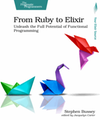
From Ruby to Elixir : unleash the full potential of functional programming
Bussey, Stephen; Carter, Jacuuelyn
Pragmatic Bookshelf
, 2024
; English
; 213 Pages
Elixir will change the way you think about programming. Use your Ruby experience to quickly get up to speed so you can see what all of the buzz is about. Go from zero to production applications that are reliable, fast, and scalable. Learn Elixir syntax and pattern matching to conquer the basics. Then move onto Elixir's unique process model that offers a world-class way to go parallel without fear. Finally, use the most common libraries like Ecto, Phoenix, and Oban to build a real-world SMS application. Now's the time. Dive in and learn Elixir. Whether you're a seasoned Ruby developer looking to expand your skill set or a programming beginner looking for a solid foundation in Elixir, this book has what you need to get up to speed quickly. Elixir is a functional language with a fairly small footprint. This makes it easier to learn and put into production than other languages. Plus, it's built on forty-year-old foundations that give your applications rock-solid stability. The first part of this book is all about developing expertise in the language. Learn about the core data types, build application data structures, enumerate over data, and use pattern matching to control the flow of an application. Elixir has an amazing process model that allows for (actually) easy parallel processing. Learn how to tap into this process model so you can leverage that power yourself. The second part of this book builds a real-world application using the most important libraries in a web developer's toolbox. Each library is compared to its similar Ruby library so you'll quickly see similarities and differences. We'll use Ecto, Phoenix, and Oban to build a SMS application powered by Twilio. What are you waiting for? Tap into your Ruby knowledge and start building scalable Elixir applications today. What You Need: You'll need Elixir 1.14+ and Erlang/OTP 24+ installed on a Mac OS X, Linux, or Windows machine.
Additional ISBNs
9798888650752
Subjects
Computers
General
Standard VitalSource Return Policy
Easy 14-day returns when
are met. View all policies.Opens in new window
Bussey, Stephen; Carter, Jacuuelyn
Pragmatic Bookshelf
, 2024
; English
; 213 Pages
Elixir will change the way you think about programming. Use your Ruby experience to quickly get up to speed so you can see what all of the buzz is about. Go from zero to production applications that are reliable, fast, and scalable. Learn Elixir syntax and pattern matching to conquer the basics. Then move onto Elixir's unique process model that offers a world-class way to go parallel without fear. Finally, use the most common libraries like Ecto, Phoenix, and Oban to build a real-world SMS application. Now's the time. Dive in and learn Elixir. Whether you're a seasoned Ruby developer looking to expand your skill set or a programming beginner looking for a solid foundation in Elixir, this book has what you need to get up to speed quickly. Elixir is a functional language with a fairly small footprint. This makes it easier to learn and put into production than other languages. Plus, it's built on forty-year-old foundations that give your applications rock-solid stability. The first part of this book is all about developing expertise in the language. Learn about the core data types, build application data structures, enumerate over data, and use pattern matching to control the flow of an application. Elixir has an amazing process model that allows for (actually) easy parallel processing. Learn how to tap into this process model so you can leverage that power yourself. The second part of this book builds a real-world application using the most important libraries in a web developer's toolbox. Each library is compared to its similar Ruby library so you'll quickly see similarities and differences. We'll use Ecto, Phoenix, and Oban to build a SMS application powered by Twilio. What are you waiting for? Tap into your Ruby knowledge and start building scalable Elixir applications today. What You Need: You'll need Elixir 1.14+ and Erlang/OTP 24+ installed on a Mac OS X, Linux, or Windows machine.
Additional ISBNs
9798888650752
Subjects
Computers
General
Standard VitalSource Return Policy
Easy 14-day returns when
are met. View all policies.Opens in new window
